
Trading Paperclips
I'm owning my learning and growth. In this post, I recount how I've prototyped my way through the last year.

Trading paperclips
Have you heard about the guy who traded a red paperclip for a house? He began by trading smaller items, starting with an actual paperclip and slowly trading up until his final trade, for a house of his own. I’ve recently leaned on that story as inspiration as I’ve reflected on my learning journey.
I’ve often said that learning is less scary when the stakes are low, and I try to do as much low-stakes learning as possible. But as I look back, I realize that each learning opportunity has been a step forward. With each one, I’m trading up to something new, exchanging each individual learning experience for slightly bigger learning experiences. To date, I’ve described using the language of experiments, but it’s all the same thing: experiments = learning. The learnings from each experiment add up, each time opening a new door of opportunity.
Brass tacks: What has this looked like?
Last year, I focused my energy on refining my point of view on what it means to be an End-of-Life Doula. Although I had completed my training and could technically call myself a Doula, I hadn’t yet had any clients. I was still timid about talking to people about death, and I was sheepish about calling myself a doula. I knew I needed to change that, so I created external accountability and deadlines because I also know that those things motivate me to take action.
I reached out to a local senior center that I have a relationship with and offered to give a talk on what an End-of-Life Doula is (EOL Doula, for short). Knowing I'd have an eager audience and a time constraint challenged me to be articulate, engaging, and concise.
I learned so much from hosting that talk. I got direct feedback on what I shared, from people who didn’t know me. People came up to me afterwards and shared their circumstances, so I got real-life stories around what they found relevant to this moment in their lives. I had created a feedback form, and what I gathered through that opened the door for other conversations. Even the CEO chimed in!
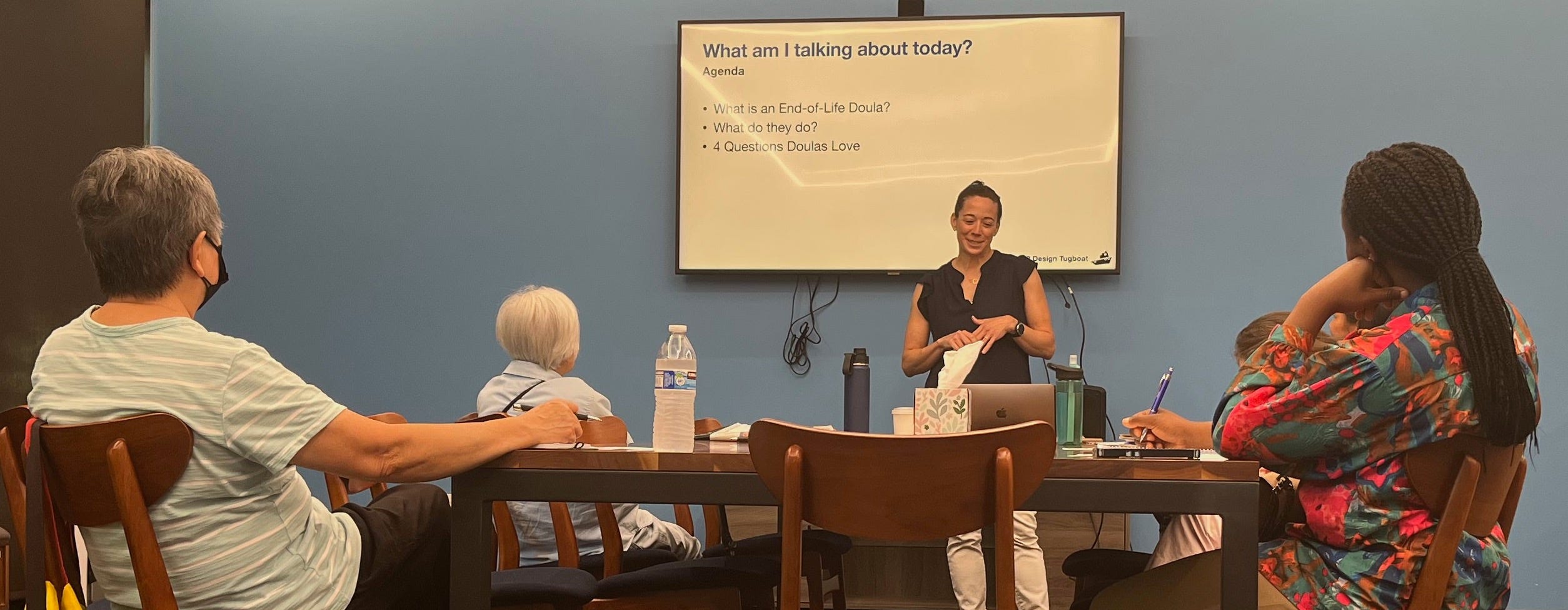
After that talk, I had rich material IN MY OWN VOICE that I could readily draw from. I used it to update my website. I use it as copy/paste material as I answered inbound questions about EOL Doulas. I traded that “paperclip” and used the newly minted content as a jumping off point when creating other materials for future events.

My next set of experiments were around grief
I work by myself and rely on several online groups for connecting with my communities. Maybe it’s because I’m an introvert, but connecting to my online communities goes a long way in helping me feel socially connected. This past Fall, I had noticed that my colleagues in the design and tech worlds had been losing jobs, changing jobs, and experiencing economic uncertainty. I could feel the pain through the screen, and everywhere I looked, I saw unaddressed grief that no one was talking about. I had something to contribute here!
I began experimenting with what it might look like to have a job loss workshop around grief. In typical Design Research fashion, I spoke to several doula and coaching colleagues* working to understand what to keep in mind when guiding people through grief. I took classes on grief. I read books and shored up my skills in guiding people through it. I heard several times that people don't often realize that they're experiencing grief. That the social stigma is so internalized that they aren’t likely to admit it to others, or even to themselves. This didn't bode well for my workshops; if no one signed up, who would I be supporting? I learned that it helps to come at grief sideways.
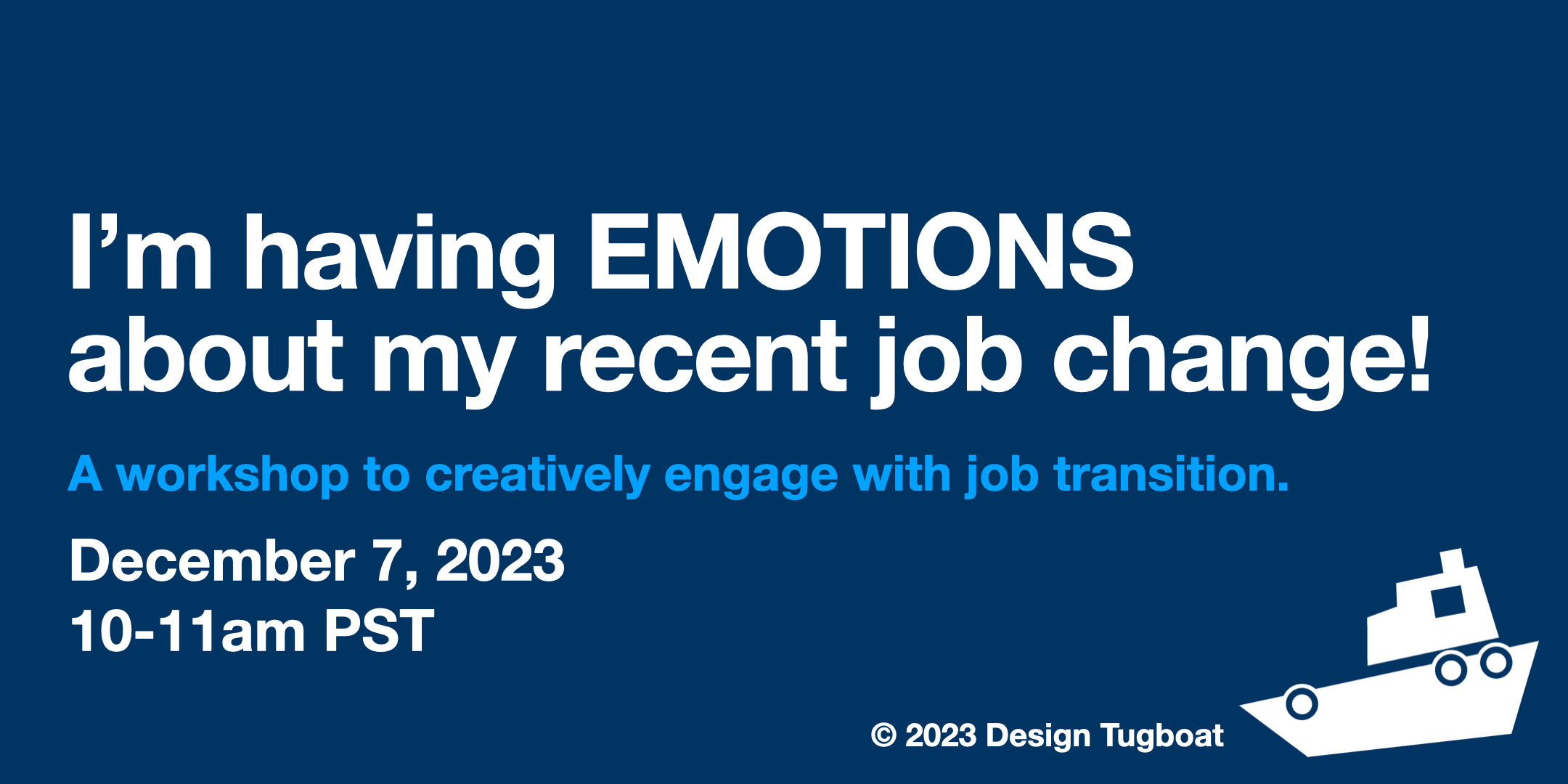
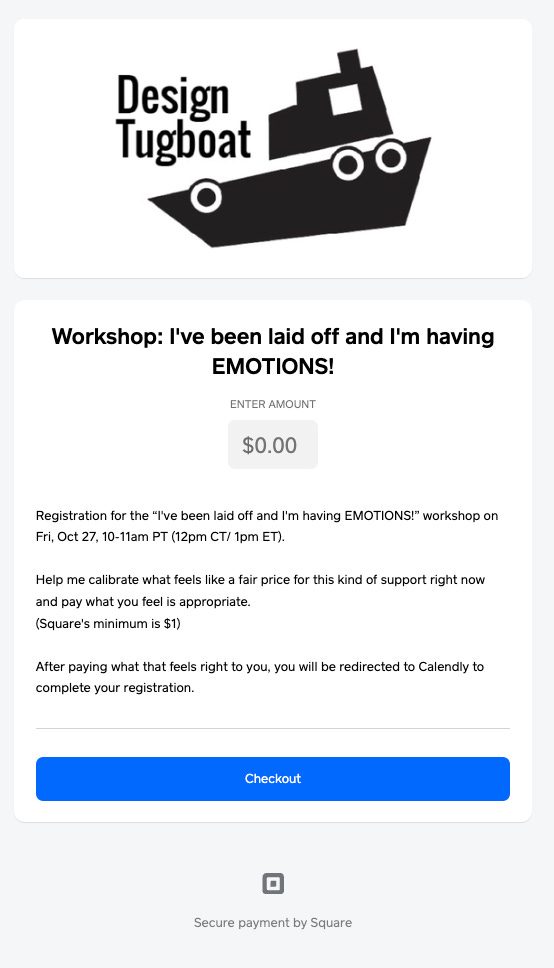
Building on what I had learned, I offered a workshop around helping people engage with difficult emotions around job loss. I intentionally avoided asking people to tackle grief head-on. I ran two workshops with a small number of people. Those workshops were my learning labs to play with not just how to guide people through grief and how to talk about it, but also how to run an online workshop. Very meta! I learned about the mechanics around taking online payments for a workshop, and I explored “pay what you think is appropriate” models to help me understand perceptions of value. I dipped my toes into how to use social media to reach beyond the communities I already touch. The results were mixed, but with each experiment, my confidence and knowledge grew.
[*Heartfelt thanks to Nikki the Death Doula and Meredith Groves who gave me guidance and feedback, and Sarah Miller who graciously invited me join her Creative Expressions Through Grief workshop as part of my grief homework.]
Ripping Off The Band-Aid: Sparking Public Conversations About Death
My next set of experiments were around inviting people into conversations more directly related to death. I had known about Death Cafes for years, but hadn’t yet felt drawn to host my own. Giving people space to talk about death in this way had previously seemed too, “Death Exploration 101,” and pre-2024 Annie was SO impatient. I didn’t want to DIP my toes into death conversations with people, I wanted to take a cannonball LEAP into them! I had wanted people to Take Action around Death Planning! I had wanted them to Make Plans!
Le sigh.
Fortunately, 2024-Annie has mellowed somewhat, LOL. Or maybe perimenopause is successfully beating me down maturing me like an excellent Scotch Whiskey. Not everyone is where I am with death. I realize now that a big piece of this work involves making death explorations accessible and actively normalizing discussions about death. With this emerging perspective, I adjusted my stance on Death Cafes and considered hosting a few.
I partnered with my friend Ka Yun, and while we were toying around with the idea of co-hosting our own Death Cafe series, we reached out to (and befriended!) other Death Cafe hosts* to hear the behind-the-scenes scoop and learn about what goes into hosting one. We visited their Death Cafes in person in Berkeley and Marin, and I attended one online to see what the experience was like without the in-person component. With a good sense of the mechanics, we committed to hosting at least two of our own Death Cafes.
[*I’m deeply grateful to Carole Silvoy, Jason Popko, Anthea Grimasen, and Karen Murray for their guidance around hosting Death Cafes, and to the amazing support of the staff at the Sunnyvale Public Library, the location host for our own South Bay Death Cafe.]
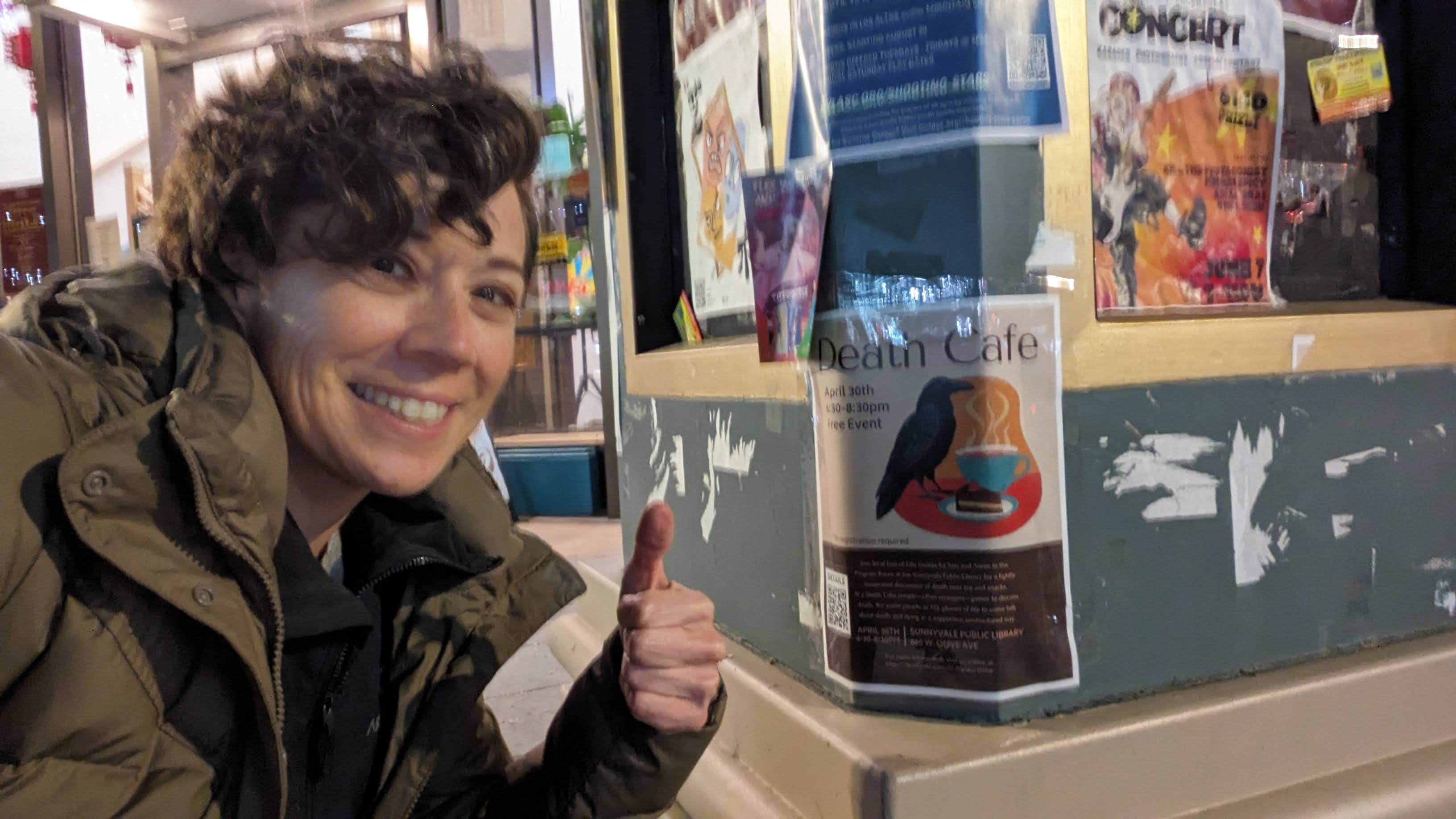
One of the few rules around Death Cafes is that they may not have an agenda of any kind, and organizers agree to no more than light moderation. Death touches so much of life that it’s hard to pigeonhole the discussion into one corner. Unsurprisingly, the conversations that arise are all over the place.
Design is a vote for the kind of world you want to live in. At the time, I wanted to see more people talking about End-of-Life planning, so in parallel to our Death Cafes, I set out to host a death-related event of my own, one where I can have more of a say in what we discuss.
My Party, My Rules!
I’ve noticed that when I tell people about my work around death, they immediately mention the people they know who are close to death, those who are old enough that their death wouldn't be a shock, people who are very ill, or someone who has died.
Graphic designers are great at seeing the spaces AROUND the objects in a design. They refer to that as negative space, and they treat it as a design element. I’m not a graphic designer, but stick with me here… I couldn’t help but notice the negative space in the conversations I was having: What ISN’T being said? What topics get ignored? What audiences are left out? In this case, I began to wonder, why don't younger people ever think about their OWN deaths?
Sadly, younger people die all the time. Healthy folks too! And countless articles and studies tell us that engaging with our mortality leads to living a more fulfilled life. How could I get people in the prime of life talking about and contemplating their mortality? Could I get younger people to move towards planning ahead?
It was time to find out.
My primary goals with this event were different from previous experiments:
This event was unmistakably about death; I wanted to see what kind of conversations the questions I had selected would enable.
What would it be like to partner with a local organization to host an event?
How might I target a different audience?
Could I use this as an excuse to learn about engaging the press? Spoiler alert: The press didn’t bite one bit.
In anticipation of an annual holiday called “National Healthcare Decisions Day” (April 16th, y’all!), I approached a local board game cafe that had recently opened, and I proposed an event to get younger folks talking about end of life planning.
Before reaching out to the cafe owners, I made it as easy as possible for them to say yes. I wrote up a formal proposal. I offered to bring snacks and coffee and keep their costs and overhead as low as possible. I wanted to show that this wasn’t way off-brand for them, so I came up with examples illustrating how existing games already talk about death and death-related topics. I volunteered some playful language they might use with their customers to talk about what we were doing. I was thrilled when they agreed to the event.
My goal was to target people in their 20s-60s, so I relied on the cafe’s contact lists and social media, and I handpicked a set of local communities for additional marketing outreach. With the younger focus in mind, I chose not to include a few communities that I knew would skew older.
I learned all about how to write a press release and alert the media, which felt simultaneously terrifying and very official. I later learned from other doulas that it had taken them at least a year of consistent press-directed efforts to get the press to show interest, which made my small effort feel much less ignored.
Given that the venue was a board game cafe, my event would involve a conversation-based card game called The Death Deck, which uses a series of questions designed to prompt discussion about death. When I reached out to the creators for guidance on hosting a public game, co-creator Lisa Pahl (swoon!) eagerly responded with tips and tricks. It turns out that the rules are wide open, so had free reign to make something up. With some guidelines in place, I quickly got to work designing the details of the event.
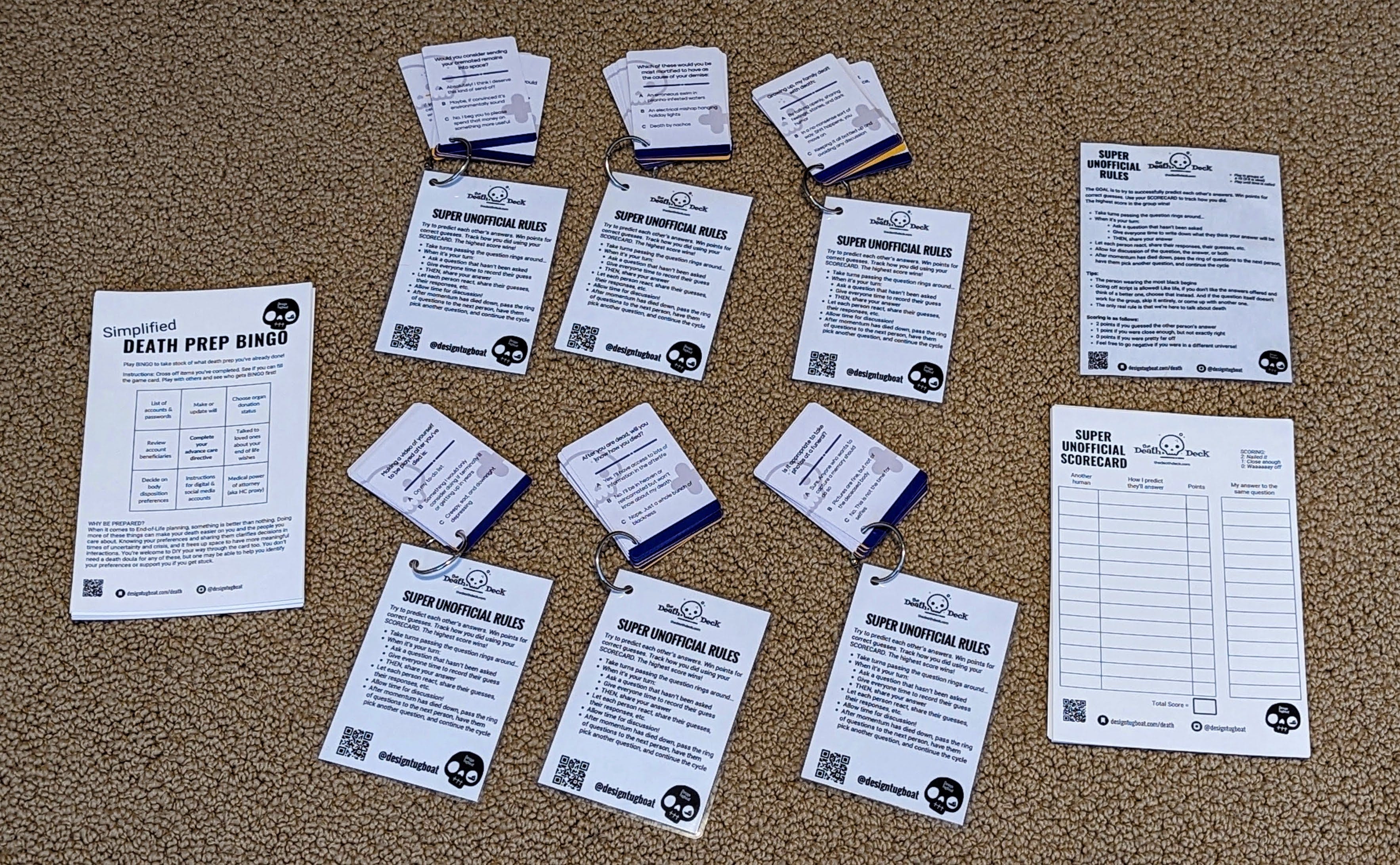
I had an absolute blast coming up with how we’d play. I hadn’t asked people to RSVP, so I didn’t know if I should expect 1 person or 100. Oops—but instant learning! My new friends at the Death Deck had suggested putting the cards on rings to allow for easy cleanup. I got to work creating rules that could still work even if the event was big enough that I couldn’t facilitate some of the groups myself. I had prizes for the winners of made-up categories. I also created a simplified Death Prep BINGO card to personalize the abstract topic of End-of-Life planning and give people something tangible as a take-away.
Fuzzy Learnings are still helpful
In full transparency, my event drew a small crowd and I'm not entirely sure what to attribute that to. There were a number of factors that might point to the low numbers:
I had tapped into a local business who was open to playing with me, but it was a new business and so their pool of customers was still pretty small.
I came up with the event on a whim, which gave me barely a month to promote it.
We held the event on a weekday morning, when the cafe is the least busy—it’s hard to compete with a gorgeous Sunday morning in April, especially in the Bay Area.
I didn't ask people to sign up in advance or RSVP, and I didn't charge money.
Any one of those factors could be to blame, and likely the full cocktail of those conditions did not work in my favor. Each one of those is a lever to experiment with in the future, if I choose.
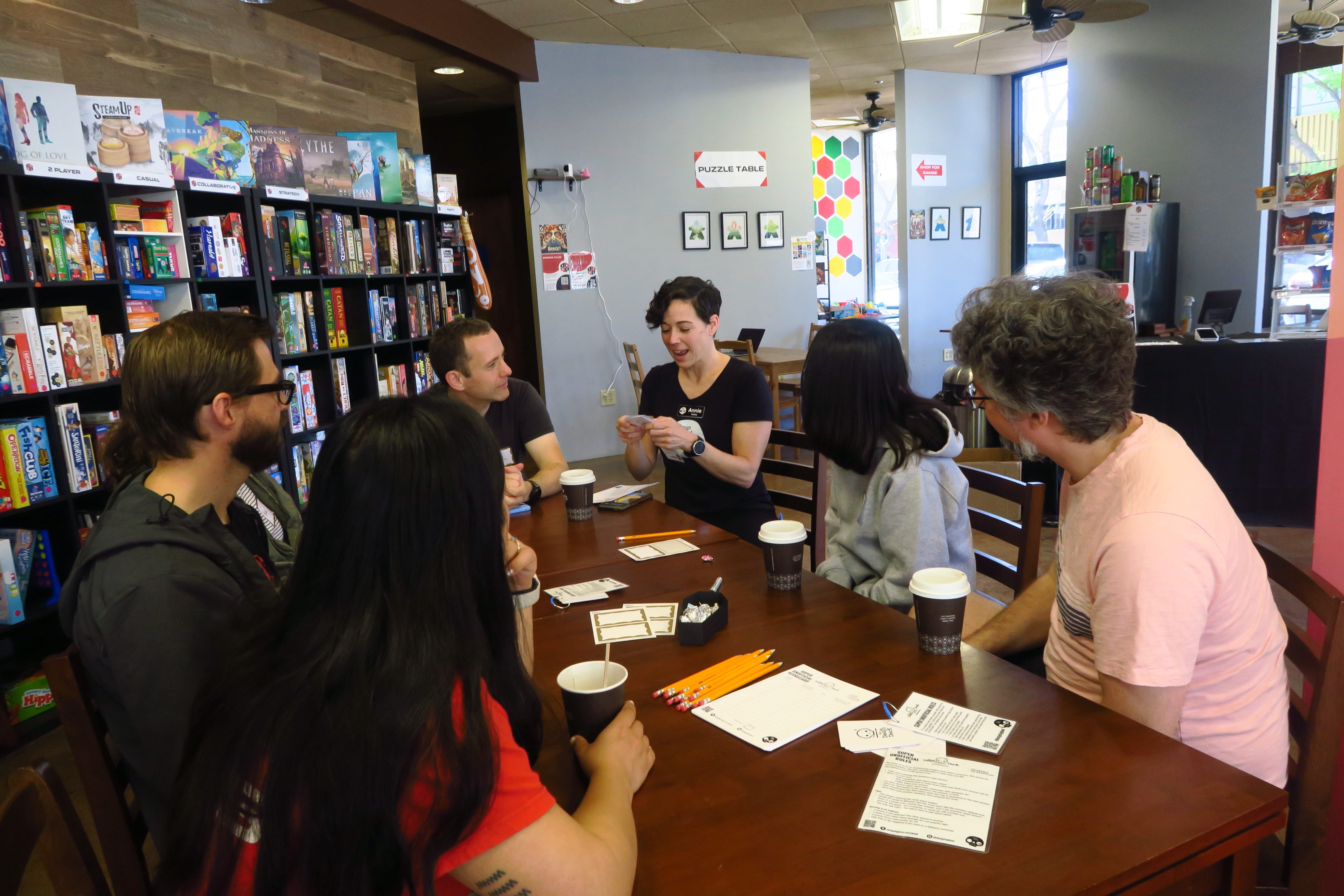
I’m optimistic that it wasn’t the topic keeping people away. We hosted our first Death Cafe around the same time, and that drew 31 people of all ages—solid reassurance that the topic of death isn’t a guarantee of crickets. In fact, we were almost overwhelmed with the positive response at the library!
The afternoon of the Death Deck event, I was initially disheartened by the turnout. Yep, I cried. After letting myself feel all the feels about it, and with a few days of distance, my mood towards the event changed. Upon reflecting, I was pretty psyched. I had designed and hosted an event! People I didn’t know had attended! They played the game! And I got great feedback from a few of the participants, including a desire for even more of an agenda, which was encouraging. I heard from them that death is so big and scary that more structure and guidance could help the conversation feel grounded and safe. My structure-loving brain tingled at hearing this.
[Serious thanks to Rebecca Wang and Sean Forman at Next Level Board Game Cafe in downtown Mountain View. I’m grateful for their willingness to entertain my out-of-the blue offer, and doing so within weeks of their wedding! Not only did they let me use their space without hesitation, but they generously broadcasted the event to their email list, and shared it across Discord, Facebook, and Instagram. It was amazing to create this connection with another small business in my community. If you like games, theirs is an excellent spot to explore.]
Up Next: Raising the Stakes
As much as I enjoy the conversations that Death Cafes invite, I feel limited by the fact that facilitators agree to NOT provide an agenda. I mentioned before that, as a Death Cafe host, I agree to let the conversation flow organically. I adhere to these agreements within the Death Cafe space, but make no mistake about it—I have a larger agenda!
While I’ll go with whatever direction the participants want in that context, there are still specific conversations I want people having. I have hypotheses about what keeps people from actually doing and documenting their End-of-Life planning. I’m still inspired by using conversations around mortality to spark people to engage with life differently. My wish list of topics of explore is long and continues to grow.
Recognizing that I craved a forum for guiding people through more topics of my choosing, I picked one and proposed a course for this coming Summer.
If you follow me on LinkedIn, you may have seen my course announcement—WOOHOO! My proposal was accepted and it is currently open for enrollment (YAY!). In a future article, I’ll share a bit more about what I hope to learn from offering this course, why I picked Stanford Continuing Studies, why it’s in-person and not online, and more.
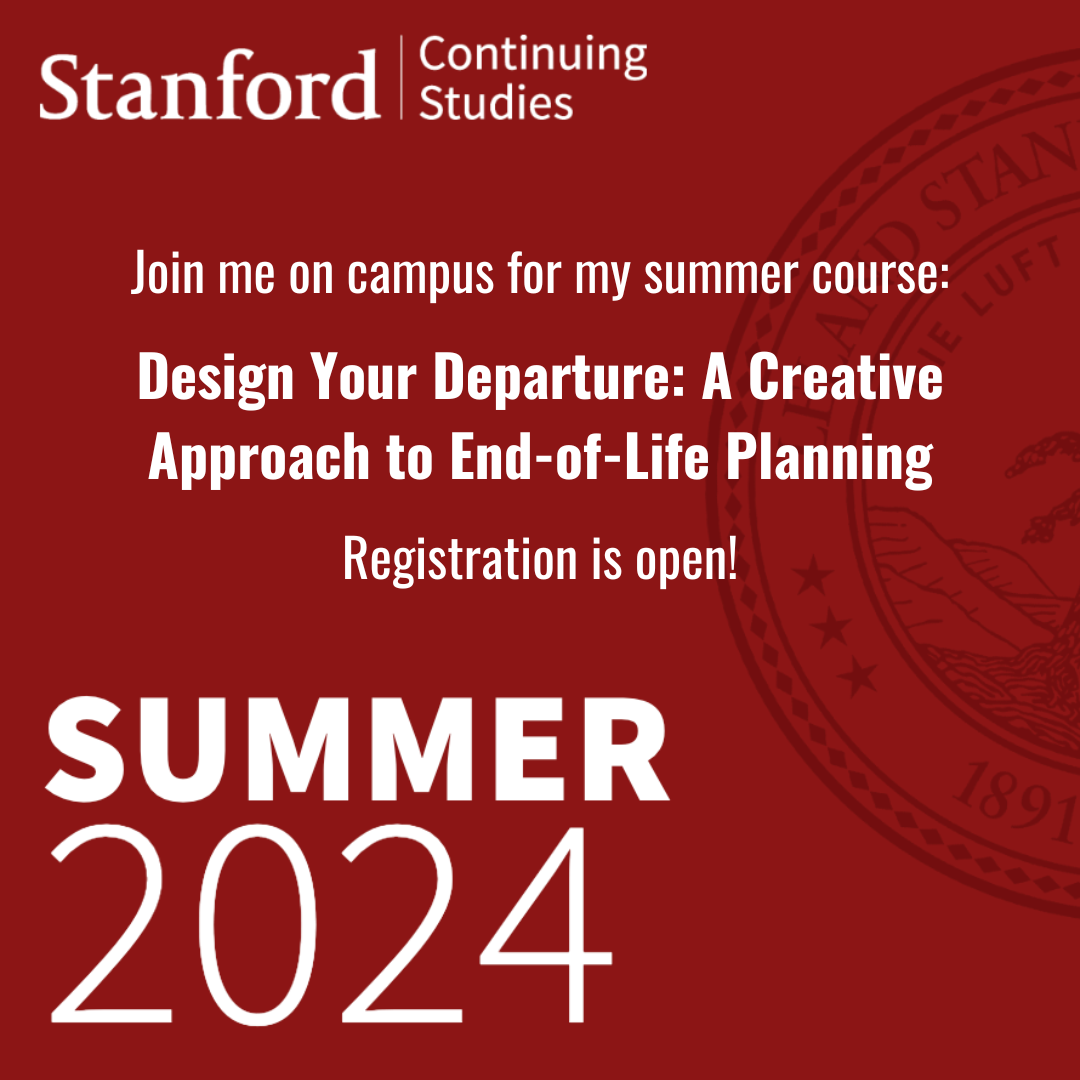
This experiment is LIVE, so if you’re in the Bay Area, I invite you to sign up for the course now! It’s called: WELL 29 — Design Your Departure: A Creative Approach to End-of-Life Planning, and registration is open.
And if you know people in the Bay Area who might be interested in taking the course, I’ve made it easy for you to spread the word. Feel free to copy / paste the following as you do so:
I thought you might be interested in a new course that my friend is teaching this summer in the Stanford Continuing Studies Program. It's called Design Your Departure: A Creative Approach to End-of-Life Planning. I think this kind of courageous exploration is right up your alley!
It runs for 6 weeks, on Monday evenings from July 8-August 12, 2024, and it'll be in person on the Stanford University campus in Palo Alto, CA.
I hear it’s a non-scary, thought-provoking, and design-informed approach to End-of-Life planning, for young and old.
Registration is now open, but I hear seats are limited. Let’s sign up!
https://continuingstudies.stanford.edu/courses/detail/20234_WELL-29
Follow my Substack so you don’t miss the rest of the behind the scenes story!
Hi Annie! Thanks so much for sharing your journey. I enjoyed reading this post today, and then within hours I listened to this podcast with Julia Louis-Dreyfus where she talked about her new movie and literally said "death doula" - not a phrase you tend to encounter twice in one day from totally different sources! https://www.nytimes.com/2024/06/08/magazine/julia-louis-dreyfus-interview.html